
On this page
Illustration generated with Cloudflare Workers AI (FLUX.2 klein)
Updated 18 Nov 2026: rewrote the page for macOS Tahoe 26, the last macOS for Intel. Corrected the CPU, GPU and Wi-Fi picks, and added compatibility tables, a hardware check and a section on Tahoe audio.
Your PC can run macOS in 2026 if it has an Intel Core 8th to 10th gen CPU (or a desktop Ryzen with community patches), Intel UHD 630 graphics or a supported AMD Radeon card, and a Wi-Fi card you can get working. The target is macOS Tahoe 26, the last macOS for Intel. macOS 27 Golden Gate runs on Apple silicon only.
The tables below come from Dortania’s OpenCore guides and the driver projects’ own pages, checked on 17 Nov 2026. The UHD 630, storage, USB, audio and webcam notes also come from a working Tahoe 26.7.3 Hackintosh that we inspected for this update.
Tested by our setup on 17 Nov 2026
- What we did: inspected a working install with read-only commands. Nothing was installed, changed or rebooted.
- On: Intel Core i9-9980HK, UHD 630, 64 GB, macOS 26.7.3 (25G342), a 30 Aug 2026 pre-release build of OpenCore 1.0.8, SMBIOS MacPro7,1
- When: 17 Nov 2026
- Not tested: a fresh install, AMD CPUs or GPUs, NVIDIA, Broadcom Wi-Fi, Intel 11th gen and newer, VGA, AirDrop and Handoff, a Wi-Fi connection, HDMI audio
- Note: SIP partly off, AMFIPass loaded, so this is not a stock setup
For a quick automated check, run the compatibility checker in OpCore Simplify, then confirm each part against the tables below.
How to check your PC’s hardware
You need three names: the CPU model, the graphics card and the Wi-Fi chip. Find them, then look each one up in the tables below.
On Windows, Settings > System > About shows the processor. Device Manager lists the graphics card under Display adapters and the Wi-Fi card under Network adapters. PowerShell gives the same names. Older guides use wmic cpu get name, but Microsoft has removed WMIC from Windows 11 24H2 and later.
Not tested: no Windows machine was used for this update. The cmdlet is from Microsoft’s Get-CimInstance reference, checked 17 Nov 2026.
Get-CimInstance Win32_Processor | Select-Object Name
Get-CimInstance Win32_VideoController | Select-Object Name
On Linux:
Not tested: no Linux machine was used for this update. From the lscpu and lspci man pages, checked 17 Nov 2026.
lscpu | grep "Model name"
lspci -nn | grep -i -E "vga|3d|network"
On a Mac or a Hackintosh you already run, for example before moving it to Tahoe:
Inspected by our setup on 17 Nov 2026: Intel Core i9-9980HK, macOS 26.7.3 (25G342).
sysctl -n machdep.cpu.brand_string
system_profiler SPHardwareDataType | grep -v -E "Serial|UUID|Provisioning"
The grep drops the serial number and UUID lines, so you can paste the output into a forum post.
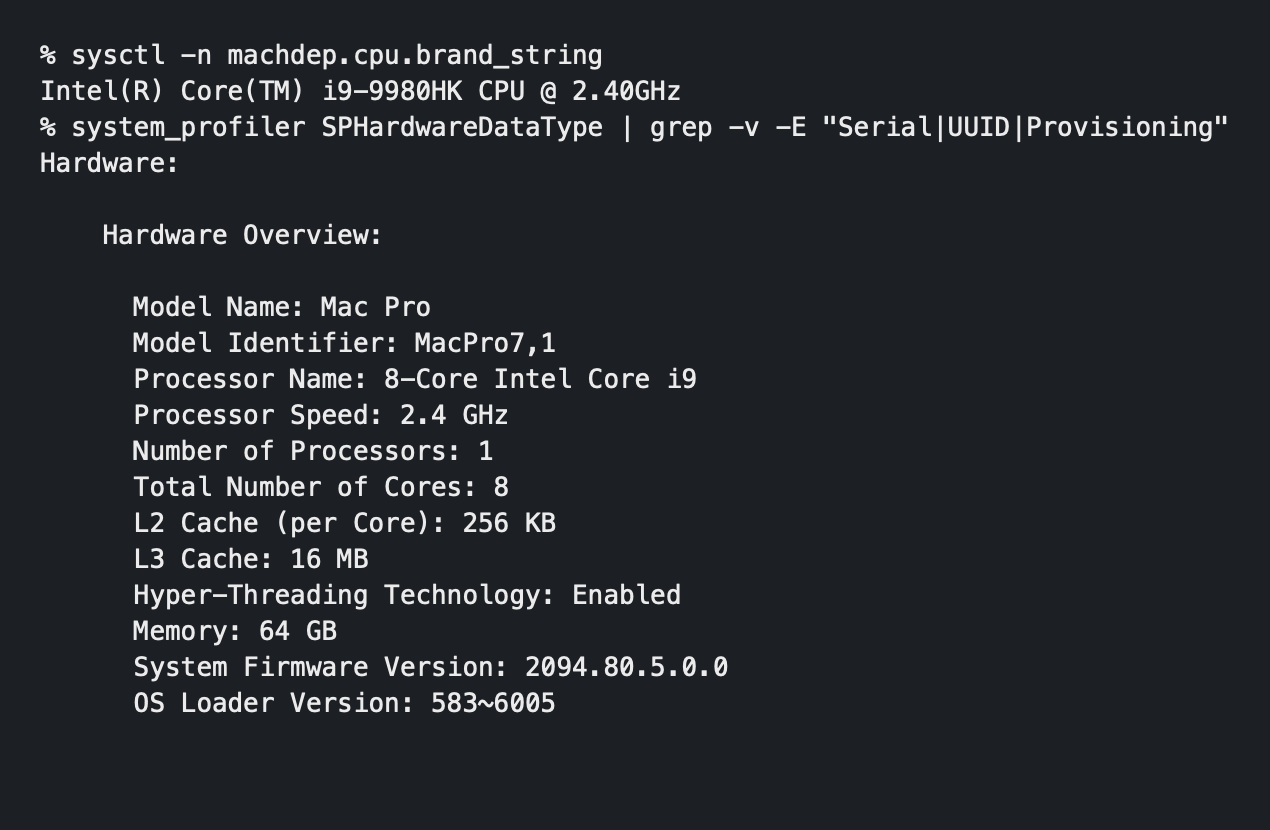
On a Hackintosh, “Model Name: Mac Pro” and the firmware version come from the SMBIOS set in OpenCore (MacPro7,1 here), not from the real hardware.
For an automated first pass, OpCore Simplify is an open-source tool for Windows, macOS and Linux with a compatibility checker step. Its README says it “does not guarantee a successful installation in the first attempt”, so check its report against the tables here.
Hackintosh minimum requirements in 2026
What you need before the parts tables matter, from Dortania’s prerequisites page and its hardware limits page, both checked on 27 Nov 2026:
- A CPU with AVX2. macOS 13 and later require it, which rules out Intel 3rd gen (Ivy Bridge) and older. Haswell (4th gen) is the floor.
- A GPU macOS can drive: Intel UHD 630 on an 8th to 10th gen CPU, or a supported AMD Radeon card. Everything else is in the GPU table below.
- A wired Ethernet connection during the install. Dortania rules out Wi-Fi dongles and says you must know your LAN card’s model. An Android phone tethered over USB with HoRNDIS is its workaround for people without Ethernet.
- A USB stick: 16 GB if you build the installer on a Mac, 4 GB on Windows or Linux.
- Free disk space on the machine you build from: 15 GB on Windows or Linux, 30 GB on a Mac.
- A SATA or NVMe drive that is not on the problem list in the storage section below.
Neither Apple nor Dortania publishes a RAM minimum for Tahoe. The machine we inspected has 64 GB, and we have no source that sets a floor.
Hackintosh hardware compatibility list at a glance
The detailed tables are below. This is the short version for a Tahoe 26 build:
| Part | Works | Avoid |
|---|---|---|
| CPU | Intel 8th to 10th gen desktop; Intel 4th to 7th gen with an AMD card; desktop Ryzen 1000 to 7000 with AMD_Vanilla | Intel 3rd gen and older (no AVX2); AMD laptop CPUs; Ryzen 9000 (not listed by AMD_Vanilla) |
| Integrated graphics | Intel UHD 630 (8th to 10th gen); HD 630 (7th gen) up to Sequoia | Every Intel Xe iGPU (11th gen and newer); Skylake iGPU |
| Graphics card | AMD RX 400 and 500, Vega, RX 5000, RX 6600, 6800 and 6900 | AMD RX 6400, 6500 and 6700; RX 7000 and 9000; Intel Arc; all NVIDIA (see the NVIDIA section) |
| Wi-Fi | Broadcom BCM94360 family on Ventura and older; BCM43602 and BCM4350 with the AppleBCMWLANCompanion beta on Sonoma to Tahoe; Intel AX200 and AX210 with AirportItlwm up to Sonoma 14.4 | Qualcomm; Intel on Sequoia or Tahoe (no AirportItlwm build) |
| Storage | Any SATA drive; most NVMe drives | Samsung PM981 and PM991, Micron 2200S, Intel 600p, Samsung 970 EVO Plus on old firmware, Optane caching |
| USB | Up to 15 ports per controller, mapped with USBToolBox | Relying on XhciPortLimit |
| Audio on Tahoe | HDMI, DisplayPort and USB audio | Onboard Realtek and Conexant codecs (AppleHDA is gone) |
The detail, and why each entry is there, follows in the sections below. For what goes wrong after a build that passes this list, see what breaks on a macOS Tahoe Hackintosh and how to fix it.
Hackintosh laptop compatibility list
There is no maintained model-by-model list; the same CPU ships in hundreds of laptops with different Wi-Fi cards, trackpads and BIOS locks. Dortania’s limits page supports Intel laptop CPUs from Arrandale through Ice Lake and no AMD laptop CPUs. Because a laptop cannot add a desktop graphics card, its iGPU decides everything:
| Laptop CPU generation | iGPU | Tahoe 26 | Why |
|---|---|---|---|
| Intel 4th and 5th gen (Haswell, Broadwell) | Haswell and Broadwell iGPUs | No | Dortania: no iGPU support on macOS 13 and later, and a laptop has no slot for an AMD card |
| Intel 6th gen (Skylake) | Skylake iGPU | No | The Skylake iGPU was dropped in Ventura |
| Intel 7th gen (Kaby Lake) | Kaby Lake iGPU | Unverified | Dortania’s table lists the iGPU up to Sequoia; Tahoe is not listed |
| Intel 8th gen (Coffee Lake U, Whiskey Lake), 10th gen (Comet Lake U) | UHD 620 | Best bet | Same driver family as the UHD 630 we inspected on Tahoe 26.7.3. Not in Dortania’s table yet |
| Intel 10th gen (Ice Lake) | Iris Plus | Supported by Dortania’s guide | The newest laptop platform Dortania covers; Tahoe is not listed yet |
| Intel 11th gen and newer (Tiger Lake, Alder Lake, Raptor Lake, Meteor Lake) | Xe or newer | No | No macOS driver for any Xe iGPU |
| Any AMD laptop | Radeon Vega or RDNA | No | Not supported by Dortania’s guide |
Laptop-specific problems that Dortania’s limits page lists, on top of the CPU rule:
- Wi-Fi: most laptop cards are Intel or Qualcomm. Intel needs AirportItlwm, which has no build newer than Sonoma 14.4, and Qualcomm has no driver at all.
- Discrete GPUs: switchable graphics means the discrete card is wired through the iGPU, and Dortania says about 90% of laptop discrete GPUs will not work. The iGPU does all the work.
- Intel Optane or Micron 3D XPoint HDD acceleration: unsupported. Remove the module or the install can fail to boot.
- Intel SST: anything connected through it, usually the internal microphone, does not work.
- Combo headphone jacks may lose audio input.
- Thunderbolt on Alpine Ridge controllers, which most current laptops have, is unreliable after sleep.
- Fingerprint readers do not work.
For the rest of a laptop build, including backlight and trackpad fixes on Tahoe, see what breaks on a macOS Tahoe Hackintosh and the macOS Tahoe Hackintosh guide.
Understanding Hackintosh compatibility
One of the most frequently asked questions in the Hackintosh community is: “Is my computer Hackintosh-compatible?” The answer depends on the processor, motherboard, GPU, storage, sound controller and network controller, and on which macOS you want to run. If you are new to all this, start with what a Hackintosh is and how it works.
In 2026 the macOS to aim for is Tahoe 26. Apple said at WWDC25 that Tahoe is the final release for Intel Macs, and macOS 27 Golden Gate, released on 14 Sep 2026, supports no Intel Mac. Tahoe still gets point updates: 26.7.3 came out on 9 Nov 2026. Use a current OpenCore as well. Version 1.0.5 fixed kext injection on macOS 26, and the newest release is 1.0.8 (27 Sep 2026).
A Hackintosh tells macOS it is a specific Mac model, the SMBIOS. Tahoe accepts four Intel models:
- MacBook Pro (16-inch, 2019)
- MacBook Pro (13-inch, 2020, four Thunderbolt 3 ports)
- iMac (Retina 5K, 27-inch, 2020)
- Mac Pro (2019)
A laptop poses as one of the MacBook Pro models and a desktop as the iMac or the Mac Pro. There is no Intel Mac mini on the list, so a NUC or other small PC can no longer pose as a Mac mini on Tahoe. The machine we inspected runs Tahoe with the Mac Pro (2019) SMBIOS, MacPro7,1.
A perfect macOS Tahoe Hackintosh in 2026: the final Intel build
Processor compatibility (Intel vs. AMD)
The CPU decides most of what follows. For Tahoe, Intel Core 8th to 10th gen desktop chips (Coffee Lake and Comet Lake) are the best fit: Dortania’s guide covers Intel desktop CPUs up to Comet Lake, and their UHD 630 graphics still work. Desktop Ryzen also runs macOS with the AMD_Vanilla patches, with some limits.
| CPU | Tahoe 26 and Sequoia 15 | Notes |
|---|---|---|
| Intel 3rd gen (Ivy Bridge) and older | No | macOS 13 and later need AVX2, which these CPUs lack |
| Intel 4th gen (Haswell) | Yes, with a supported AMD GPU | Dortania lists the CPU as current; its iGPU stopped at macOS 12 |
| Intel 6th gen (Skylake) | Yes, with a supported AMD GPU | The Skylake iGPU was dropped in Ventura |
| Intel 7th gen (Kaby Lake) | Yes | Its HD 630 iGPU is in Dortania’s table up to Sequoia; Tahoe is not listed yet |
| Intel 8th to 10th gen (Coffee Lake, Comet Lake) | Yes, the best fit | UHD 630 works. F-series chips have no iGPU. Inspected on 26.7.3 with an i9-9980HK |
| Intel 11th gen desktop (Rocket Lake) | With a Comet Lake CPUID and a supported AMD GPU | The Xe iGPU has no macOS support |
| Intel 12th and 13th gen (Alder Lake, Raptor Lake) | Outside Dortania’s guide | OpenCore has CPU support code for both; the iGPU has no driver, so you need a supported AMD GPU |
| Intel Core Ultra (Arrow Lake) | Outside Dortania’s guide | OpenCore 1.0.3 added Arrow Lake CPU detection; Dortania does not list its graphics |
| AMD Ryzen 1000 to 7000, desktop | Yes, with AMD_Vanilla patches | Ryzen 7000 (Zen 4) also needs the IOPCIFamily patch |
| AMD Ryzen 9000 (Zen 5) | Not listed by AMD_Vanilla | |
| AMD laptop CPUs | No | Not supported by Dortania’s guide |
Intel
Intel processors are still the easiest to work with, as long as you stay inside Dortania’s range. Coffee Lake and Comet Lake are the sweet spot because both the CPU and its iGPU work; older chips back to Haswell need a supported AMD card. From 11th gen on, the iGPU is Intel Xe or newer, which macOS has no driver for, and an 11th gen desktop CPU also needs a Comet Lake CPUID. OpenCore has had Alder Lake support code since late 2021 and fixed Raptor Lake detection in 1.0.3, but Dortania’s guide stops at Comet Lake, so on 12th gen and newer you are on your own for the rest of the setup.
AMD
Ryzen CPUs work with macOS through the AMD_Vanilla kernel patches and OpenCore 0.7.1 or newer. AMD_Vanilla covers Ryzen from the first generation through Zen 4 (Ryzen 7000) and lists Tahoe among its supported versions. Ryzen 9000 is not listed.
The missing Intel Quick Sync Video engine, which affects hardware acceleration for video editing, is the smaller problem. Dortania’s hardware limits page lists bigger ones for AMD: no virtual machines that use Apple’s hypervisor (VirtualBox, VMware, Parallels and Docker), crashes in some Adobe apps, and problems in apps built on Intel’s MKL maths library.
Verdict: if you’re building a Hackintosh from scratch, go with an Intel 8th to 10th gen CPU unless you’re comfortable troubleshooting AMD-specific issues.
CPUs to avoid
- Intel 3rd gen (Ivy Bridge) and older: no AVX2, so nothing newer than macOS 12.
- AMD laptop CPUs: not supported.
- Intel 12th gen and newer, if you want a build that a maintained guide covers end to end.
Related guide: macOS Tahoe, the last macOS for Intel, and what it means for Hackintosh
Motherboard compatibility
Dortania’s rule is that, for the most part, any motherboard works as long as its CPU is supported. So choose the CPU first and a board to match it.
| CPU | Chipsets | Status |
|---|---|---|
| Intel 8th and 9th gen | 300 series (for example Z370, Z390) | Covered by Dortania’s guide |
| Intel 10th gen | 400 series (for example B460, Z490) | Covered by Dortania’s guide |
| Intel 11th gen | 500 series (for example B560, Z590) | Needs a Comet Lake CPUID |
| Intel 12th gen and newer | 600 and 700 series (for example Z690, Z790) | Outside Dortania’s guide |
| AMD Ryzen | B450, B550, X570 | Works with AMD_Vanilla |
Dortania’s old warning about MSI A520, B550 and X570 boards no longer applies: current AMD_Vanilla patches fix them.
Built-in Wi-Fi follows the same rules as a separate card, so look up the board’s Wi-Fi chip in the Wi-Fi table below.
Tip: popular motherboards usually have better Hackintosh guides and community support.
Related guide: Advanced Hackintosh ACPI: a deep dive into SSDT selection and configuration
Graphics card compatibility
macOS has no driver for any current NVIDIA card or for Intel’s Xe graphics, so a Tahoe Hackintosh runs on Intel UHD 630 (8th to 10th gen) or a supported AMD Radeon card. Among AMD cards, the RX 400 and 500 series, Vega, the RX 5000 series and some RX 6000 cards work. The RX 7000 series does not.
Dortania’s GPU tables stop at Sequoia 15, so for most cards there is no Tahoe verdict yet.
| GPU | Sequoia 15 | Tahoe 26 | Notes |
|---|---|---|---|
| Intel UHD 630 (8th to 10th gen) | Yes | Yes on the machine we inspected (26.7.3); not in Dortania’s table yet | F-series CPUs have no iGPU |
| Intel HD 630 (7th gen) | Yes | Not in Dortania’s table yet | |
| Intel Skylake iGPU (6th gen) | No | No | Dropped in Ventura |
| Intel Xe iGPUs (11th gen and newer: Tiger Lake, Rocket Lake, Alder Lake, Raptor Lake, Meteor Lake) | No | No | No support in any version of macOS |
| AMD RX 400 and RX 500 (Polaris) | Yes | Not in Dortania’s table yet | Not the RX 580 2048SP or RX 590 GME. Needs a CPU with AVX2 |
| AMD Vega | Yes | Not in Dortania’s table yet | |
| AMD RX 5000 (Navi 10, Navi 14) | Yes | Not in Dortania’s table yet | |
| AMD RX 6800 and RX 6900 (Navi 21), RX 6600 (Navi 23) | Yes | Not in Dortania’s table yet | |
| AMD RX 6700 (Navi 22) | Only with NootRX, a work in progress | Not in Dortania’s table yet | NootRX has moved off GitHub; we could not read its current status |
| AMD RX 6400 and RX 6500 (Navi 24) | No | No | |
| AMD RX 7000 (Navi 3x) | No | No | Dortania calls support “unlikely” |
| Intel Arc | No | No | Dortania: “All of them are unsupported”. Its list names the Alchemist cards |
| AMD RX 9000 | No macOS driver; not listed by Dortania | No macOS driver; not listed by Dortania | |
| NVIDIA Kepler (GTX 680, GTX 770, GK208 GT 710 and GT 730) | No | No | Native up to Big Sur 11, dropped in Monterey |
| NVIDIA Maxwell and Pascal | No | No | Last worked on High Sierra 10.13.6 with NVIDIA’s web drivers |
| NVIDIA Turing, Ampere and Lovelace | No | No | Never had macOS drivers |
Intel iGPU
Intel UHD 630 on 8th to 10th gen CPUs works well with macOS. On the Tahoe 26.7.3 machine we inspected, the UHD 630 (device ID 0x3e9b) reports Metal 3 and drives a 1920 x 1080 monitor at 144 Hz. You can check your own iGPU the same way:
Inspected by our setup on 17 Nov 2026: Intel Core i9-9980HK, macOS 26.7.3 (25G342).
system_profiler SPDisplaysDataType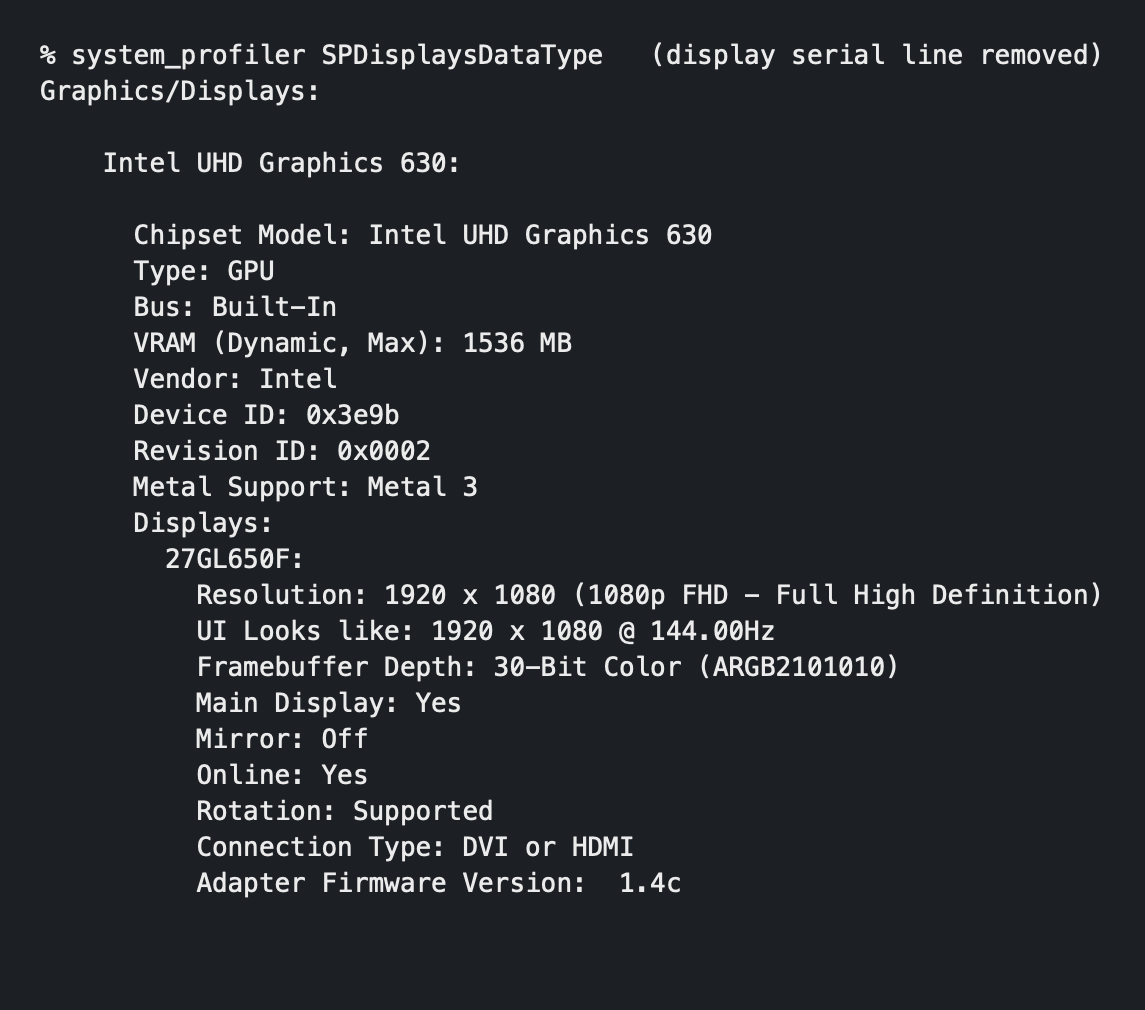
Intel Xe graphics (11th gen and later) do not work. Dortania’s Intel GPU guide says the Tiger Lake and Rocket Lake Xe iGPUs have no support in any version of macOS, and lists the Alder Lake, Raptor Lake and Meteor Lake iGPUs as unsupported too. With one of these CPUs, you need a supported AMD card.
AMD GPUs (recommended)
Supported AMD cards work natively with macOS, without extra drivers: the RX 400 and RX 500 series, Vega, the RX 5000 series, and the RX 6000 cards built on Navi 21 or Navi 23. In the RX 6000 series, check which chip your card uses before you buy.
On Tahoe, Dortania’s Tahoe page reports AMD connector patching issues with WhateverGreen on macOS 26 and says to remove WhateverGreen if it causes a kernel panic. If you relied on its agdpmod=pikera boot argument, you then have to apply that fix by hand, as the Tahoe page describes.
NVIDIA GPUs
GTX and RTX cards do not work in modern macOS. Dortania’s NVIDIA guide says: “There are no currently supported NVIDIA GPUs.” Kepler cards (GTX 680, GTX 770, and the GK208 versions of the GT 710 and GT 730) worked natively up to Big Sur 11. The Fermi versions of the GT 710 and GT 730 stop at High Sierra 10.13.6, like Maxwell and Pascal.
OpenCore Legacy Patcher (OCLP) has root patches that bring back Kepler acceleration on newer macOS, with Tahoe support only in its 3.0.0 pre-release. OCLP is built for real Macs.
A third-party project, NullMoth, is writing a Metal driver for GeForce cards on Sequoia and Tahoe. We have not tested it; what it needs and what users report is in our NullMoth guide.
Wi-Fi and Bluetooth compatibility
No Wi-Fi card works out of the box on Sonoma, Sequoia or Tahoe. Apple removed Broadcom Wi-Fi support in Sonoma, so the Broadcom cards Hackintosh builders used to buy now need root patches or a beta kext, and Intel cards need a third-party kext on every version. If kexts are new to you, see what kexts are in macOS and Hackintoshes.
| Card | Ventura 13 and older | Sonoma 14 and Sequoia 15 | Tahoe 26 |
|---|---|---|---|
| Broadcom BCM94360CS2, BCM94352Z, BCM94360NG | Works natively | OCLP Modern Wireless root patch, with SIP lowered | OCLP 3.0.0 root patch, still a pre-release on 17 Nov 2026 |
| Broadcom BCM43602 and BCM4350 cards (BCM943602CS, BCM943602CDP, BCM94350ZAE, DW1830, DW1820A) | BCM943602CS and BCM94350ZAE are in Dortania’s buyers guide | AppleBCMWLANCompanion beta (Intel CPUs only); BCM4350 cards also have the OCLP root patch | AppleBCMWLANCompanion beta (its developer tested 26.0 to 26.1) |
| Intel AX200, AX210 | AirportItlwm | AirportItlwm release builds go up to Sonoma 14.4; none for Sequoia | No AirportItlwm release build |
Broadcom (needs patches since Sonoma)
Up to Ventura, a Broadcom card was the standard pick because macOS drove it natively. Since Sonoma there are two routes, and neither is out of the box:
- OCLP root patches. They need SIP lowered, and OCLP is built for real Macs. The latest stable release, 2.5.1, has no Tahoe support. The Tahoe Wi-Fi patches are in 3.0.0, which was still a release candidate (3.0.0-rc.5, 28 Oct 2026) when we checked.
- AppleBCMWLANCompanion. Its README says it is in beta testing and not recommended for daily use. It supports only BCM43602 and BCM4350 chips, so the BCM94360 cards above are not on its list. It needs VT-d, so AMD systems cannot use it.
We found no documentation from either project for AirDrop, Sidecar or Apple Watch unlocking on Tahoe. The setup for both routes is in our Broadcom Wi-Fi guide for Sonoma, Sequoia and Tahoe.
Intel Wi-Fi (needs a third-party kext)
Intel AX200 and AX210 cards can work with the OpenIntelWireless drivers (itlwm and AirportItlwm), but without full macOS feature support. Their newest release, v2.3.0 from 9 Jun 2024, has AirportItlwm builds only up to Sonoma 14.4.
AirDrop does not work with AirportItlwm. Handoff (from phone to Mac only, on Monterey and newer) and Universal Clipboard do, according to the project’s FAQ.
For Intel Bluetooth, the newest IntelBluetoothFirmware release is v2.4.0 (27 Feb 2024), and Dortania’s Tahoe page names the -ibtcompatbeta boot argument for Intel Bluetooth on macOS 26.
Verdict: pick by macOS version and CPU.
- Staying on Ventura or older: a Broadcom BCM94360-family card still works natively.
- Sonoma, Sequoia or Tahoe on an Intel CPU: a BCM43602 or BCM4350 card with AppleBCMWLANCompanion (beta), or a Broadcom card with OCLP root patches and SIP lowered.
- An AMD CPU: AppleBCMWLANCompanion needs VT-d, so for Broadcom that leaves the OCLP root patches.
Audio on macOS Tahoe
Tahoe removed AppleHDA, Apple’s driver for onboard audio codecs. AppleALC, the kext most Hackintoshes use for onboard sound, stops working with it, so analog audio through Realtek and Conexant codecs no longer works. Digital audio over HDMI, DisplayPort and USB still works, according to Dortania’s Tahoe page. Getting analog audio back needs workarounds that lower SIP; we did not test them.
On the machine we inspected, the /System/Library/Extensions folder has no AppleHDA.kext, and although AppleALC 1.9.8 is loaded, macOS shows no onboard audio device. The only audio devices are USB ones (a headset, the webcam’s microphone and a DisplayLink USB audio device) and an iPhone’s Continuity microphone. We did not check HDMI audio. Plan on USB or HDMI audio for a Tahoe build.
Inspected by our setup on 17 Nov 2026: Intel Core i9-9980HK, macOS 26.7.3 (25G342).
ls /System/Library/Extensions | grep -i AppleHDA
system_profiler SPAudioDataType
No output from the first line means AppleHDA is gone.
Monitor compatibility
Use HDMI or DisplayPort. VGA from an Intel iGPU usually works by default on Skylake (6th gen) and newer, but hot-plugging a VGA monitor usually does not, and Ivy Bridge has no VGA output since OS X 10.8.2, according to WhateverGreen’s Intel FAQ.
On the machine we inspected, the UHD 630 drives a 1920 x 1080 monitor at 144 Hz; macOS reports the connection as “DVI or HDMI”. For a comfortable macOS desktop, aim for at least 1920 x 1080 (Full HD).
Storage: HDD vs. SSD
Dortania says all SATA drives and most NVMe drives work. A few NVMe models cause kernel panics, so check the model before you buy.
SSDs that work
- SATA SSDs and most NVMe SSDs give fast boot times and smooth performance.
- The machine we inspected has a Crucial P3 Plus 1 TB (CT1000P3PSSD8) with TRIM on and NVMeFix 1.1.4 loaded, on Tahoe 26.7.3.
NVMeFix is a kext for NVMe power management. It does not make the problem drives below safe.
Drives to avoid
- Samsung PM981, Samsung PM991 and Micron 2200S. They cause kernel panics and, in Dortania’s words, “may still cause boot issues even with NVMeFix.kext”.
- Intel 600p, which Dortania lists as troublesome.
- Samsung 970 EVO Plus drives on old firmware. A firmware update fixed them, so update before you install.
- Intel Optane memory as a cache: macOS does not support Optane acceleration.
- HDDs as the boot drive: slow.
USB compatibility
macOS supports USB 2.0, 3.0 and USB-C, but it allows only 15 ports per USB controller. Most boards have more, so you map the ports you use and leave the rest out. Improper USB mapping can lead to connectivity issues.
The 15-port limit
The XhciPortLimit quirk lifts the limit, but Dortania’s USB mapping guide says it can lead to data corruption and tells you to avoid it when possible. OpenCore 1.0.7 improved XhciPortLimit compatibility with Tahoe, but the advice to map your ports still stands. The machine we inspected runs USBToolBox 1.2.0 on both of its USB controllers.
Related guides:
- Create a bootable macOS USB drive using gibMacOS
- Make a bootable macOS USB using Mist
- How to do USB mapping for Hackintosh in Windows
Peripherals and accessories
- Webcams: UVC-compliant webcams work out of the box. On the machine we inspected, macOS detects a Logitech Brio 100. We did not record video with it.
- Keyboards and mice: basic functionality works; advanced features may require the maker’s software.
Is your PC ready for a Hackintosh?
Even with the right hardware, Hackintosh installations require patience and troubleshooting. If your CPU, GPU and Wi-Fi card all have a “Yes” in the tables above, you’re in a good position to install macOS Tahoe on non-Apple hardware. Tahoe is the last stop: you get 26.x point updates, but no macOS 27.
Compatible? Next, build your EFI with the macOS Tahoe Hackintosh guide.
A perfect macOS Tahoe Hackintosh in 2026: the final Intel build
If you run into issues, start with Dortania’s OpenCore Install Guide and its troubleshooting pages. Also, feel free to ask questions in the Hackintosh community or drop a comment below.
Changes
- 18 Nov 2026: rewrote the page for macOS Tahoe 26 as the last Intel release. Added CPU, GPU and Wi-Fi tables by macOS version, a hardware check with commands, a Tahoe audio section and a sources list.
- 18 Nov 2026: corrected the Intel CPU range, the GPU picks (no RX 7000, only some RX 6000, no Intel Xe), the Broadcom advice (no native Wi-Fi since Sonoma), the Intel Wi-Fi features, VGA support, the NVMe advice and the dual boot FAQ.
- 18 Nov 2026: replaced the stock photos and the 2020 cover photo with terminal screenshots from a Tahoe 26.7.3 machine we inspected.
- 27 Nov 2026: added a minimum requirements section from Dortania’s prerequisites, a one-table compatibility list, a laptop compatibility table by CPU generation with Dortania’s laptop limits, a pointer to NullMoth in the NVIDIA section, links to the Tahoe fixes guide, and five FAQs.
Frequently asked questions
Can I Hackintosh a laptop?
Yes, but it is harder than a desktop. Dortania's guide supports Intel laptop CPUs only up to Ice Lake (10th gen) and no AMD laptop CPUs. Most laptop Wi-Fi cards are Intel or Qualcomm chips with no native macOS driver. About 90% of laptop discrete GPUs will not work, so you run on the iGPU. Fingerprint sensors do not work either. Locked BIOS settings and unsupported trackpads are common problems too, depending on the model.
Do I need a Mac to create a Hackintosh?
No. Windows and Linux can make the online (recovery) installer, which downloads macOS during the install. Only the full offline installer needs a Mac. See how to make a macOS bootable USB on Windows.
Can I update macOS on a Hackintosh?
Yes, within macOS Tahoe 26. You get Tahoe 26.x point updates, but macOS 27 Golden Gate (released 14 Sep 2026) supports Apple silicon only, so there is no macOS 27 for an Intel Hackintosh. On macOS 14.4 and later, over-the-air updates need RestrictEvents with revpatch=sbvmm and SecureBootModel set to Disabled, or the iBridged kext if you want to keep secure boot on. Updates can still break things, so back up before you update. The steps are in how to update your Hackintosh.
Why doesn’t my NVIDIA GPU work?
macOS has no drivers for any current NVIDIA card. Dortania's GPU guide says "There are no currently supported NVIDIA GPUs." Kepler cards (GTX 680, GTX 770 and the GK208 versions of the GT 710 and GT 730) worked natively up to Big Sur 11. Maxwell and Pascal stopped at High Sierra 10.13.6 with NVIDIA's web drivers, and Turing, Ampere and Lovelace never had macOS drivers. OpenCore Legacy Patcher can add Kepler acceleration on newer macOS (Tahoe only in its 3.0.0 pre-release), but it is built for real Macs. Use a supported AMD card instead.
What’s the best way to dual boot macOS and Windows?
OpenCore's boot picker starts both systems. Partition the disk with Disk Utility or the Windows installer; OpenCore does not partition disks. See the Hackintosh dual boot guide and the OpenCore dual boot guide.
What are the minimum requirements for a Hackintosh in 2026?
A CPU with AVX2 (Intel Haswell or newer, or a desktop Ryzen), a GPU macOS has a driver for (Intel UHD 630 on 8th to 10th gen, or a supported AMD Radeon), a wired Ethernet port for the install, and a SATA or NVMe drive that is not on Dortania's problem list. For the installer you need a 16 GB USB stick if you make it on a Mac, or 4 GB on Windows or Linux, plus 15 GB of free disk space on Windows or Linux or 30 GB on a Mac. Neither Apple nor Dortania publishes a RAM minimum for Tahoe.
Which CPUs are supported for a Hackintosh?
Dortania's guide covers Intel desktop CPUs from Yonah through Comet Lake (10th gen) and Intel laptop CPUs from Arrandale through Ice Lake, but macOS 13 and later need AVX2, so Haswell (4th gen) is the real floor for Tahoe. Intel 8th to 10th gen is the best fit because the UHD 630 iGPU still works. Desktop Ryzen 1000 to 7000 runs with the AMD_Vanilla patches. AMD laptop CPUs are not supported.
Is there a Hackintosh laptop compatibility list?
Not a model-by-model one that is maintained; laptops vary too much. The rule is by CPU: Intel 8th to 10th gen U-series laptops (Coffee Lake, Whiskey Lake, Comet Lake, Ice Lake) with UHD 620 or Iris Plus graphics are the ones Dortania's guide covers for current macOS. Expect to replace the Wi-Fi card or live without it, to lose any discrete GPU, and to lose the fingerprint reader. The laptop table in this guide goes through it generation by generation.
Can a 12th gen or newer Intel CPU run macOS?
The CPU can: OpenCore has had Alder Lake support code since late 2021 and added Arrow Lake detection in 1.0.3. The iGPU cannot, because macOS has no driver for Intel Xe or newer graphics, so you need a supported AMD card, and Dortania's guide stops at Comet Lake, so there is no maintained walkthrough for the rest of the setup.
What is the best GPU for a Hackintosh in 2026?
An AMD card macOS drives natively: the RX 5700 XT or another RX 5000 card, an RX 6600, 6800 or 6900, or an older RX 580 or Vega. Intel UHD 630 on an 8th to 10th gen CPU is enough for a desktop without a card. Avoid the RX 6400, 6500 and 6700 (no or partial support), every RX 7000 and 9000 card, Intel Arc, and NVIDIA, which has no Apple driver on any current macOS; the third-party NullMoth project is the only route for GeForce cards, and we have not tested it.
Comments 1
Ayush Chaudhary
Sure! Happy to help. What info are you looking for?
Report comment by Ayush ChaudharyReport