
On this page
To check for updates on a Mac or a Hackintosh, choose System Settings from the Apple menu, click General in the sidebar, then click Software Update. Software Update looks for new Apple software on its own. To check again, Apple says to click Check for Updates, press Command-R, or close and reopen Software Update. On a Hackintosh with macOS 14.4 or later, Software Update only works once RestrictEvents is set up (see below).
Check for updates in System Settings
Updates fix security problems and bugs and bring new features to your apps. Apple recommends running the latest macOS your Mac supports, for its security, stability and compatibility. macOS shows a notification when updates are available, but you can also check by hand, or change what your Mac does with updates in the background.
Check for updates manually
To see which updates are available for macOS:
- Open the Apple menu and choose System Settings.
- Click General in the sidebar, then Software Update.

If there is nothing to install, you’ll see a screen like this one, from macOS Sequoia 15.3.1 in February 2025.
- If an update is listed, click the button to install it. macOS asks for your administrator password before the installation starts.
- To check again, click Check for Updates or press Command-R.
If an update you expect isn’t there, Apple says Software Update only offers software that is compatible with your Mac model. When your Mac doesn’t need an update or can’t run it, Software Update says your Mac is up to date. On a Hackintosh, also read the RestrictEvents note at the end of this guide.
This is how Software Update looked on macOS Catalina in April 2020:

Stop macOS from installing updates by itself
If you want to stay on your current version of macOS:
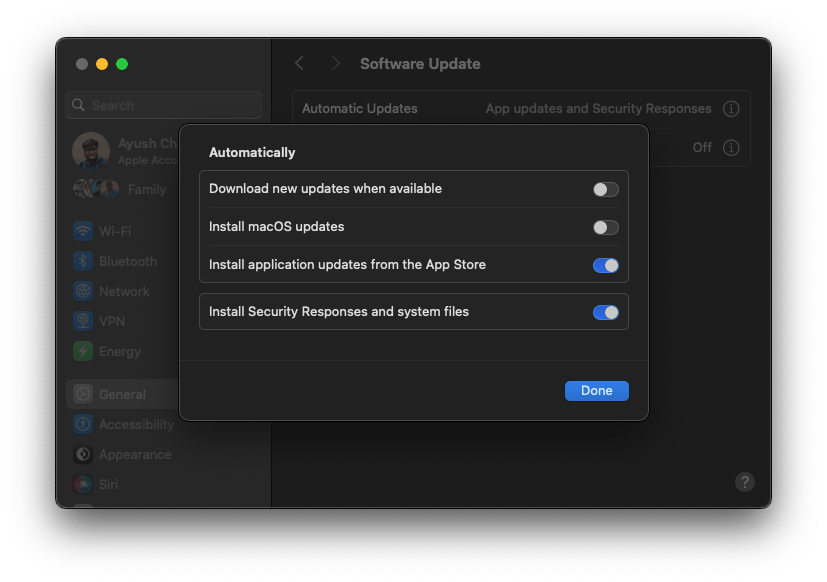
- In Software Update, click the info button (i) next to Automatic Updates.
- Turn off Install macOS updates and Download new updates when available, then click Done.
On Catalina, these options were behind the Advanced button in the screenshot above.
Turn automatic updates on or off
The same sheet controls what your Mac downloads and installs by itself. Open System Settings > General > Software Update and click the info button (i) next to Automatic Updates.
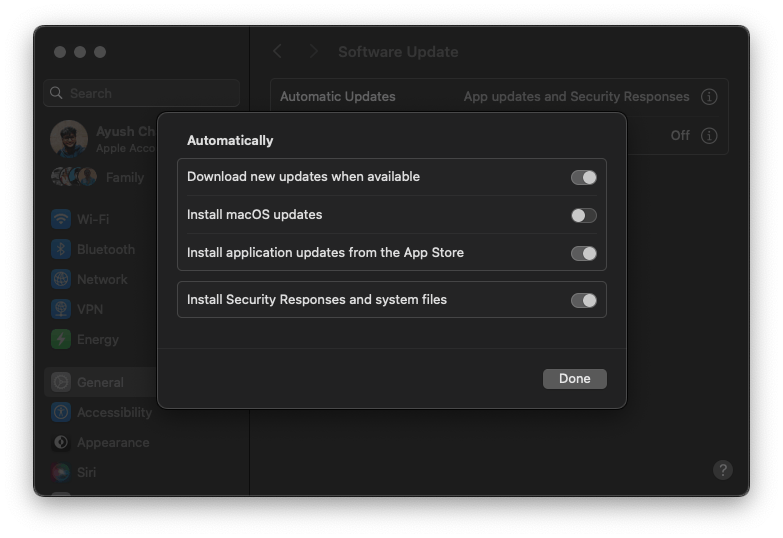
On macOS Sequoia 15.3.1 it had four switches:
- Download new updates when available downloads updates in the background.
- Install macOS updates installs macOS updates automatically.
- Install application updates from the App Store installs app updates automatically.
- Install Security Responses and system files installs security fixes and system data files automatically.
On macOS Tahoe, our Hackintosh update guide found three switches: the first two, plus Install system data files and security updates.
Apple asks you to let an installation finish without putting your Mac to sleep or closing its lid. On a Hackintosh, either setting of Install macOS updates works, as long as you keep a backup EFI that boots.
If you need a full macOS installer instead, for example to make a bootable USB drive, see our guide to Mist.
Before you update a Hackintosh
On a Hackintosh, Software Update is the last step. Back up your working EFI, then update OpenCore and your kexts. On macOS 14.4 and later, Dortania says over-the-air updates only work on a Hackintosh with RestrictEvents and revpatch=sbvmm. Our guide to updating your Hackintosh has every step for macOS Tahoe.
How to update your Hackintosh: OpenCore, kexts and macOS Tahoe



Comments
No comments yet.
Report