
On this page

Updated 18 Nov 2026: replaced the 2023-era picks with models current as of November 2026, added licence, release date and download size for each, corrected wrong claims about MythoMax, Pygmalion, Dolphin and WizardLM, ran the picks that fit on an 8 GB GPU, and added sections on open video models and on consent and the law.
As of November 2026, the open source NSFW AI models for text are mostly uncensored versions of current open-weight models: on 17 Nov 2026 the 12 models tagged “uncensored” with the most Hugging Face downloads in the past 30 days were all built on Qwen, and role-play fine-tunes such as Artemis and Cydonia are built on Gemma 4 and Mistral Small. For images, newer open bases such as FLUX, Chroma, Z-Image and Qwen-Image now sit next to the older Stable Diffusion checkpoints. For video, the official open bases include Wan, LTX, MiniMax-H3 and PAN2. In our test on an 8 GB graphics card, the two 12B role-play models, Dolphin X1 Trinity Nano and Stable Diffusion 1.5 ran fully on the GPU. No video model’s official files fit in 8 GB.
You’re here because you want models that don’t refuse a dark or mature prompt. Adult content is part of that, and so is unfiltered art or a story with mature themes that a mainstream model would refuse to write. Whether you’re an author writing a gritty crime novel, an artist working on mature themes, or a developer building a role-playing game with realistic dialogue, you need models that trust your judgment.
This list covers text, image and video models, with the licence, release date and download size of each, and a link to its Hugging Face card. Looking for an uncensored local LLM for coding, research or privacy instead? Our uncensored AI models guide covers which one fits your GPU, with benchmarks.
A quick disclaimer: These tools are powerful. They are meant for artists, writers, developers and researchers who create responsibly. Never use them to make sexual images of a real person without their consent. See consent, licences and the law below.
Tested by our setup on 18 Nov 2026
- What we did: ran the 3 text picks that fit in 8 GB of VRAM, plus Stable Diffusion 1.5, with every layer on the GPU, and measured VRAM use and speed. We checked each file’s sha256 against Hugging Face and gave each model one neutral prompt. Earlier, we ran 2 older models from the 2025 list CPU-only to check their context length and peak memory
- On: AMD Radeon RX 5700 XT 8 GB (custom undervolt, 195 W cap) passed through to a Debian 13 VM on Proxmox, llama.cpp b12445 and stable-diffusion.cpp master-1043-3be2378, both on Vulkan, 4,096-token context. Older models: Intel Core i9-9980HK, 64 GB RAM, macOS 26.7.3, llama.cpp v1.0.0 (b1b770d), CPU only
- When: 17 and 18 Nov 2026
- Not tested: the 7 text picks and 10 image bases that are too big for 8 GB, SDXL, the community checkpoints, any video model, other context sizes, stock GPU clocks, NVIDIA cards, Apple silicon, output quality or how often any model refuses
Why open source is the usual path for NSFW AI
The reason is control. Open models give creators three things that hosted, closed models don’t.
- Fewer refusals, but not zero rules: Mainstream closed models are governed by content policies, so they can refuse a prompt that is only dramatic or controversial. The official instruct releases of open models are usually trained to refuse too, and they ship with a licence. What changes is that anyone can modify the weights. Community fine-tunes and abliterated versions remove most refusals, but the licence still applies (see the licence columns below).
- Community-driven fine-tuning: A company releases a base model, such as Qwen, Google’s Gemma, Mistral or Black Forest Labs’ FLUX (earlier, Meta’s Llama and Stability AI’s Stable Diffusion). Developers on Hugging Face then fine-tune it on new data, such as fiction, role-play logs or a specific art style. Today most refusal removal is done by abliteration, a method based on the 2024 paper “Refusal in Language Models Is Mediated by a Single Direction”: it finds that direction in the weights and removes it. Tools such as Heretic (v2.1.0, 8 Nov 2026, AGPL-3.0) automate it.
- Privacy and local hosting: When you use a closed model through an API, your prompts go to the company’s servers. When you run an open model locally, your prompts and outputs stay on your machine.
The best open source NSFW AI models for text (LLMs)
These are the picks as of 17 Nov 2026. “4-bit file” is the download size of one 4-bit GGUF file, the format llama.cpp loads. It sets a floor for RAM or VRAM; context and runtime overhead come on top. We ran the three picks that fit in 8 GB of VRAM (results below the tables) but did not compare output quality, so the notes come from each model card.
Creative writing and role-play models
| # | Model | Built on | Licence | Repo created | 4-bit file |
|---|---|---|---|---|---|
| 1 | Artemis 31B v1.2 | Gemma 4 31B it | not tagged (base: Apache 2.0) | 25 Sep 2026 | 19.52 GB (Q4_K_M) |
| 2 | Orion 26B-A4B v1.1 | Gemma 4 26B-A4B it | not tagged (base: Apache 2.0) | 13 Sep 2026 | 17.97 GB (Q4_K_M) |
| 3 | Cydonia 24B v4.3 | Mistral Small 3.2 24B Instruct 2506 | not tagged (base: Apache 2.0) | 8 Nov 2025 | 14.33 GB (Q4_K_M) |
| 4 | Rocinante X 12B v1 | Mistral Nemo Instruct 2407 | not tagged (base: Apache 2.0) | 19 Jan 2026 | 7.48 GB (Q4_K_M) |
| 5 | Pygmalion-3 12B | Mistral Nemo Base 2407 | Apache 2.0 | updated 19 Feb 2025 | 7.48 GB (Q4_K) |
- Artemis, Orion, Cydonia and Rocinante (TheDrummer): The author’s cards say his models are “geared towards creativity, usability, and entertainment” and aimed at “use cases which require no alignment”. Artemis and Orion are the newest, both on Gemma 4. The Artemis v1.2 card is mostly user praise, which we have not checked. None of the four has a licence tag on the Hub, so read the card and the base model’s licence before using one in a product. The GGUF files in the Rocinante X repo are named v1b, and v1b is the file we ran.
- Pygmalion-3 12B: PygmalionAI calls it “our latest roleplaying model”, trained on “hundreds of millions of tokens of conversations, creative writing and instructions”. The card says it was not fine-tuned to be safe, that its intended use is fictional writing for entertainment, and that outputs “might often be factually wrong or misleading”. It replaces Pygmalion 2 7B from the old list.
If you’d rather use a hosted chat service than run a model yourself, see NSFW AI chat platforms.
Uncensored chat and instruction models
| # | Model | Built on | Licence | Repo created | 4-bit file |
|---|---|---|---|---|---|
| 6 | Huihui Qwen3.6 35B-A3B abliterated | Qwen3.6-35B-A3B (35.95B) | Apache 2.0 | 19 May 2026 | 21.71 GB (Q4_K) |
| 7 | Huihui Qwen3.8 27B abliterated | Qwen3.8-27B (27.78B) | Apache 2.0 | 16 Aug 2026 | 16.81 GB (Q4_K) |
| 8 | Gemma 4 31B it ARA heretic | Gemma 4 31B it (31.27B) | Apache 2.0 | 7 Nov 2026 | 18.69 GB (Q4_K_M) |
| 9 | Dolphin Mistral 24B Venice Edition | Mistral Small 24B Instruct 2501 (24.01B) | Apache 2.0 | 12 Jun 2025 | no GGUF file in the official repos |
| 10 | Dolphin X1 Trinity Nano | Arcee Trinity Nano Preview (6.12B) | Apache 2.0 | 29 May 2026 | 3.64 GB (MXFP4) |
- The two Huihui models: Both are abliterated versions of Qwen’s own models. The cards call the method “a crude, proof-of-concept implementation to remove refusals”. On 17 Nov 2026 they were the two most downloaded models with the “uncensored” tag on Hugging Face, with about 5.1 million and 4.3 million downloads in 30 days.
- Gemma 4 31B it ARA heretic: GGUF files from mradermacher of a Heretic-modified Gemma 4 31B. The source repo it was converted from is gated.
- Dolphin: The series is still built as an uncensored general assistant, and its repos now live under huggingface.co/dphn. The Venice Edition card says it was made “with the goal of creating the most uncensored version of Mistral 24B”. Dolphin X1 Trinity Nano, from 29 May 2026, is the newest Dolphin release, and its card says it is the first trained with RL environments “aimed to de-align models”. Both cards say you set the alignment through the system prompt, and the Trinity Nano card adds that you are responsible for any content you generate.
What runs on an 8 GB GPU
Three of the ten picks fit on an 8 GB card with every layer on the GPU at a 4,096-token context. The other seven have 24B parameters or more, and their 4-bit files are bigger than 8 GB (Dolphin Venice has no official GGUF file at all), so part of each would have to run on the CPU. We did not run them.
Tested by our setup on 18 Nov 2026 on an AMD Radeon RX 5700 XT 8 GB (custom undervolt) in a Debian 13 VM, llama.cpp b12445 (Vulkan), 4,096-token context.
| Model and file | Layers on GPU | VRAM used (model + KV cache + compute) | VRAM left | Prompt, pp512 (tokens/s) | Generation, tg128 (tokens/s) |
|---|---|---|---|---|---|
| Dolphin X1 Trinity Nano, MXFP4, 3.64 GB | 57/57 | 3,463 MiB (3,260 + 161 + 42) | 4,705 MiB | 2,769.02 | 147.26 |
| Rocinante X 12B v1b, Q4_K_M, 7.48 GB | 41/41 | 7,513 MiB (6,763 + 640 + 110) | 649 MiB | 363.53 | 42.99 |
| Pygmalion-3 12B, Q4_K, 7.48 GB | 41/41 | 7,513 MiB (6,763 + 640 + 110) | 645 MiB | 363.11 | 41.50 |
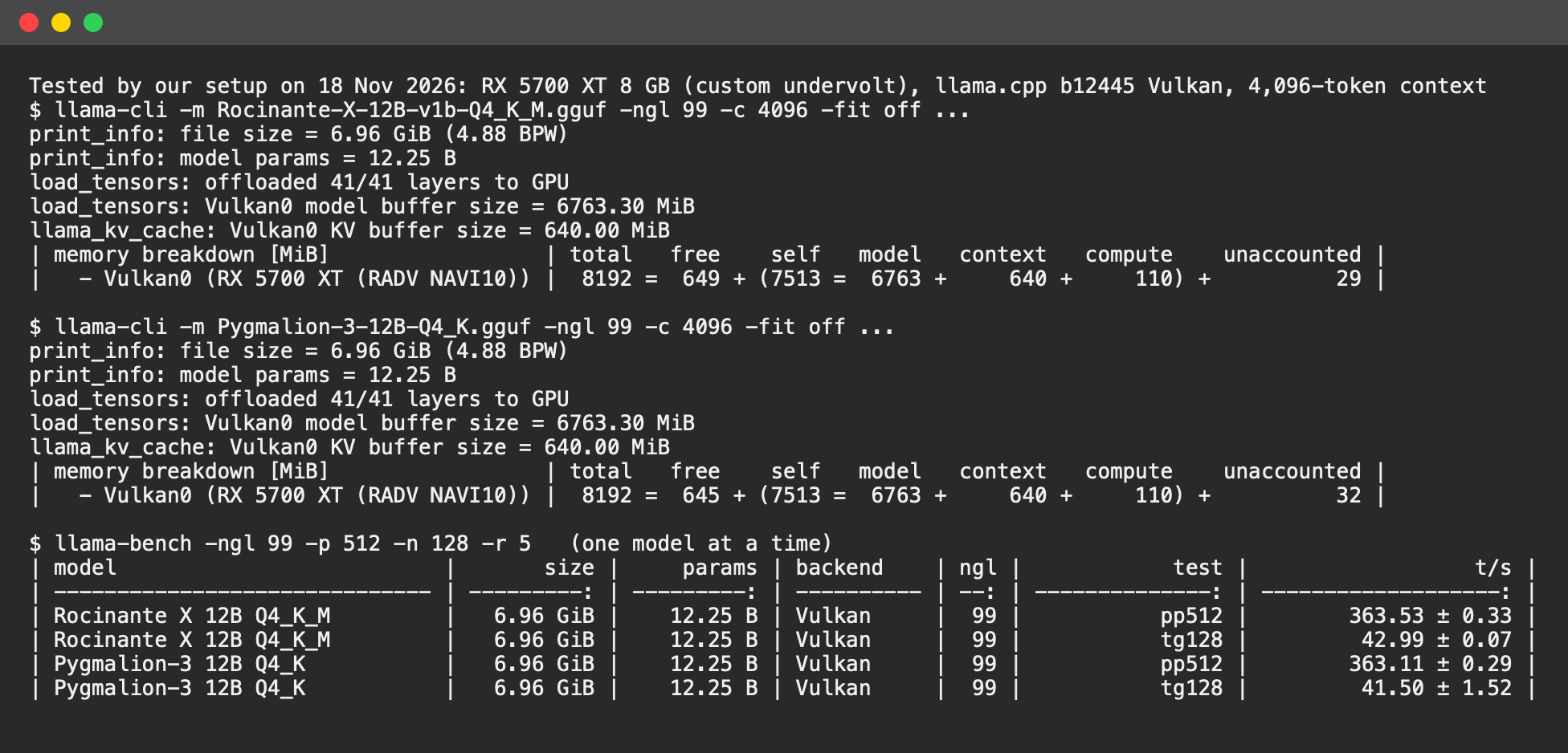
Rendered from our logs, with the commands shortened. llama-bench names both 12B files “llama 13B Q4_K - Medium”, so we put the model names in its rows.
Both 12B files leave about 650 MiB free at 4,096 tokens. Their KV cache takes 640 MiB per 4,096 tokens, so an 8,192-token context would need about all of what is left. That is our estimate from the logs; we did not run 8,192. Dolphin X1 Trinity Nano used 3,463 MiB, less than half the card.
llama.cpp always keeps the token-embedding table in system RAM (208 MiB for Dolphin, 360 MiB for each 12B model), and every layer ran on the GPU. Each model got one neutral prompt, the opening of a mystery story set in a lighthouse, and we did not judge the answers.
The speeds come from an undervolted card (2,000 MHz core limit, 195 W cap), so a stock RX 5700 XT may score differently. llama-bench crashed with a segmentation fault in 2 of 8 runs, each time right after a llama-cli run. The reruns finished, and their numbers are in the table.
Tested by our setup on 18 Nov 2026 on an RX 5700 XT 8 GB, llama.cpp b12445 (Vulkan). -ngl 99 puts every layer on the GPU, and -fit off stops llama.cpp from shrinking the context or moving layers to the CPU to make a model fit.
llama-cli -m Rocinante-X-12B-v1b-Q4_K_M.gguf -ngl 99 -c 4096 -fit off -n 200 --temp 0 --seed 1 -st --simple-io -v \
  -p "Write a 120-word opening paragraph for a mystery story set in a lighthouse." < /dev/null
llama-bench -m Rocinante-X-12B-v1b-Q4_K_M.gguf -ngl 99 -p 512 -n 128 -r 5
Older models from the 2025 list
All ten text models in the 2025 version of this list date from May 2023 to April 2024, and newer models have replaced them.
- MythoMax-L2-13B (Aug 2023): a merge of MythoLogic-L2 and Huginn on Llama 2 13B, not a plain fine-tune. Its context is 4,096 tokens, which is a few thousand words, not “tens of thousands”. Its own card now says: “With Llama 3 released, it’s time for MythoMax to slowly fade away”.
- Pygmalion 2 7B (Sep 2023): a Llama 2 7B fine-tune for fiction and conversation, replaced by Pygmalion-3 12B above.
- Mixtral 8x7B (Dec 2023): a mixture-of-experts model with 8 experts, 2 used per token, 46.7B parameters, a 32,768-token context and an Apache 2.0 licence. Dolphin 2.5 Mixtral (Dec 2023) and Nous-Hermes 2 Mixtral 8x7B (Jan 2024) were built on it. Dolphin 2.5 was not the latest Dolphin even when this list was first written.
- Airoboros-L2-70B (Jul to Oct 2023), Xwin-LM-70B (Sep 2023) and OpenChat 3.5 (Oct 2023): all Llama 2 or Mistral 7B era. The old list said Xwin topped the Open LLM Leaderboard, but its card’s claim was first place on AlpacaEval in Sep 2023 (95.57% against Text-Davinci-003). OpenChat’s card reported an MT-bench score of 7.81.
- Guanaco-65B (May 2023): a QLoRA adapter on LLaMA 1 65B, trained on OASST1 and “purely intended for research purposes” under the LLaMA licence.
- WizardLM-2-8x22B (Apr 2024): the official
microsoft/WizardLM-2-8x22Brepo is gone. The weights survive only as community mirrors such as alpindale/WizardLM-2-8x22B.
On 17 Nov 2026 we ran two of these older models CPU-only to check their real context length and memory use:
| Model (Q4_K_M) | File size | Context | Peak memory footprint | Max resident set size |
|---|---|---|---|---|
| MythoMax L2 13B | 7.87 GB | 4,096 tokens | 9.0 GiB | 16.4 GiB |
| Pygmalion 2 7B | 4.08 GB | 4,096 tokens | 5.1 GiB | 8.9 GiB |
The safe RAM figure sits between the two memory numbers, and only for these settings: 4,096-token context, CPU only, memory-mapped file. A smaller context or other flags change it. We measured on a 64 GB machine, so these are peaks, not proven minimums. MythoMax does not fit whole on an 8 GB GPU at its 4,096-token context (7.33 GiB of weights plus a 3,200 MiB KV cache), so we did not run it on the GPU.
You can check a GGUF file’s trained context length yourself. Look for context_length and n_ctx_train in the verbose load log.
Tested by our setup on 17 Nov 2026 on an Intel Core i9-9980HK, 64 GB RAM, macOS 26.7.3, llama.cpp v1.0.0 (b1b770d), CPU only.
./build/bin/llama-cli -m models/mythomax-l2-13b.Q4_K_M.gguf -t 8 -n 1 -st --simple-io -v -p "Say hi."Output of that run, trimmed to three lines.
llama_model_loader: - kv   2:                       llama.context_length u32              = 4096
print_info: n_ctx_train           = 4096
print_info: model params          = 13.02 B
Project “Home Brain”: self-host private AI on CasaOS with Ollama
Open source NSFW AI models and tools for images
Stable Diffusion is no longer the centre of the open image scene. On 17 Nov 2026, none of the 25 trending text-to-image models on Hugging Face was a Stable Diffusion model; the list was led by MiniMax-H3-Image, Qwen-Image 2.1, FLUX.1 and Krea 2. SD 1.5 and SDXL are still downloaded heavily, about 1.16 million and 4.8 million times in the last 30 days. For more on how hosted and local image generators differ, see our comparison of censored vs uncensored AI image generators and our list of AI image generators without restrictions.
Foundational models
Licences differ a lot between these bases, so check the licence column before you build anything commercial. “Gated: yes” means you accept the terms on Hugging Face before you can download.
| Model | Created on the Hub | Licence (Hub tag) | Parameters | Gated |
|---|---|---|---|---|
| Stable Diffusion 1.5 | 30 Aug 2024 (community mirror) | creativeml-openrail-m | 0.86B | no |
| SDXL base 1.0 | 25 Jul 2023 | openrail++ | 2.57B | no |
| Stable Diffusion 3.5 Large | 22 Oct 2024 | stabilityai-ai-community | 8.15B | yes |
| FLUX.1 schnell | 31 Jul 2024 | apache-2.0 | 11.89B | yes |
| FLUX.1 dev | 31 Jul 2024 | flux-1-dev-non-commercial-license | 11.9B | yes |
| Chroma1-HD | 8 Aug 2025 | apache-2.0 | 8.9B | no |
| FLUX.2 dev | 22 Nov 2025 | flux-non-commercial-license | 32.2B | yes |
| Z-Image-Turbo | 25 Nov 2025 | apache-2.0 | 6.15B | no |
| Krea 2 Raw | 18 Jun 2026 | krea-2-community-license | 12.8B | yes |
| Qwen-Image 2.1 | 14 Sep 2026 | qwen-research | 7.1B | no |
| MOSS-Image SFT | 11 Oct 2026 | apache-2.0 | 5.08B | no |
| MiniMax-H3-Image | 3 Nov 2026 | minimax-h3-image-community-license-agreement | not listed | no |
- Stable Diffusion 1.5: The oldest base still in wide use. RunwayML’s original repo is deprecated, and the old ID now points to the community mirror. It was trained at 512×512.
- SDXL: The SDXL paper describes training on several aspect ratios at about 1024×1024 pixels of area.
- Chroma1-HD: An 8.9B base built on FLUX.1 schnell under Apache 2.0, which its card describes as a starting point for fine-tuning.
The licence names are as tagged on the Hub. We have not read every licence text, so read it on the model card before you use a model.
Stable Diffusion 1.5 ran fully on our 8 GB RX 5700 XT. All 2,111 MB of its weights went to VRAM, peak VRAM use was 4.27 GB, and one 512×512 image at 20 steps took 20.4 s including the model load, of which 16.5 s was sampling. The prompt was a lighthouse painting. We looked at the image and deleted it, and this page has no sample images.
SDXL is borderline on 8 GB. Its fp16 file is 6.94 GB, and by our estimate a 1024×1024 decode would not fit with everything on the GPU and no tiling. We did not run it. Every other base in the table has official weights over 8 GB, and we did not load the community checkpoints below.
Tested by our setup on 18 Nov 2026 on an RX 5700 XT 8 GB in a Debian 13 VM, stable-diffusion.cpp master-1043-3be2378 (Ubuntu 24.04 Vulkan build). --type f16 converts the weights to f16 as they load. The newest release that day, master-1106-532d2c1, has a Vulkan build for Ubuntu 26.04 only, and that build needs glibc 2.43, which Debian 13 does not have.
sd-cli -m v1-5-pruned-emaonly.safetensors --type f16 -p "a lighthouse on a rocky coast at dusk, oil painting" -W 512 -H 512 --steps 20 -s 42 -vCommunity checkpoints for SD 1.5 and SDXL
These are fine-tuned versions of SD 1.5 or SDXL that you load into a UI to get a specific style. All of them date from 2023.
| Checkpoint | Base | Licence | Created |
|---|---|---|---|
| Realistic Vision V5.1 | SD 1.5 | creativeml-openrail-m | 31 Jul 2023 |
| DreamShaper 8 | SD 1.5 | creativeml-openrail-m | 26 Aug 2023 |
| DreamShaper XL 1.0 | SDXL | openrail++ | 26 Aug 2023 |
| Deliberate | SD 1.5 | CC BY-NC-ND 4.0 (stated in the README) | 24 Oct 2023 |
| Counterfeit-V3.0 | SD 1.5 | creativeml-openrail-m | 28 Apr 2023 |
- Realistic Vision: A photorealistic SD 1.5 checkpoint. A V6.0 B1 followed on 29 Nov 2023, and its card says it is not yet the full version.
- DreamShaper: A general-purpose checkpoint with an SD 1.5 version and an SDXL version.
- Deliberate: Its README states CC BY-NC-ND 4.0, which rules out commercial use. The repo has files up to v6.
- Counterfeit-V3.0: An anime-style checkpoint, last updated 9 Nov 2023.
- Rev Animated and Anything V5: Dropped from this list. Neither has a repo from its author on Hugging Face, only third-party mirrors.
Tools and techniques
- LoRAs (Low-Rank Adaptation): Small add-on weights you apply on top of a checkpoint to steer the style, a subject or an object without retraining the whole model. The method comes from the LoRA paper.
- ControlNet: Conditions a generation on a reference, such as a pose, a sketch or a depth map, instead of relying on the prompt alone. The original repo (Apache-2.0) has not changed since 9 Sep 2023, so check that a ControlNet model exists for the base you pick.
- ComfyUI and AUTOMATIC1111: ComfyUI is a node-based interface for building repeatable workflows. It moved to the Comfy-Org account and ships often: v0.45.0 came out on 10 Nov 2026 (GPL-3.0). AUTOMATIC1111’s web UI (AGPL-3.0) has had no commit on its master branch since 27 Jul 2024, and v1.10.1 is still its latest release. Its fork Forge last changed on 26 Jun 2025. Our view: A1111 used to be the easier start for beginners, but without updates we would start with ComfyUI today.
Open source AI video models
As of 18 Nov 2026, the official open video models on Hugging Face include Wan 2.1 and 2.2, LTX-2.3 and LTX-2.5, MiniMax-H3 and PAN2, released between Feb 2025 and Oct 2026. None of them runs whole on an 8 GB GPU from its official files. We don’t list the fine-tunes and LoRAs built on them.
| Model | Created on the Hub | Licence (Hub tag) | Parameters | Main official files | Gated |
|---|---|---|---|---|---|
| Wan2.1-T2V-1.3B | 25 Feb 2025 | apache-2.0 | 1.42B | model 5.68 GB, text encoder 11.36 GB | no |
| Wan2.2-TI2V-5B | 18 Jul 2025 | apache-2.0 | 5B | model 20.01 GB in 3 files, text encoder 11.36 GB | no |
| Wan2.2-T2V-A14B | 24 Jul 2025 | apache-2.0 | 27B, 14B active per step | two experts at 57.15 GB each, text encoder 11.36 GB | no |
| LTX-2.3 | 4 Mar 2026 | ltx-2-community-license-agreement | 22B | full model 46.15 GB | no |
| LTX-2.5 | 23 Jul 2026 | ltx-2.x-community-license-agreement | 22B | transformer 42.02 GB (bf16) or 18.72 GB (nvfp4), text encoder 26.26 GB | yes |
| MiniMax-H3 | 28 Jul 2026 | minimax-h3-community-license-agreement | 33.12B | transformer 66.28 GB, text encoder 66.73 GB | no |
| PAN2 | 7 Oct 2026 | apache-2.0 | 29.2B | transformer 67.37 GB | no |
- Wan 2.1 and Wan 2.2 (Wan-AI): The 1.3B model makes 480P video, and its card says it needs 8.19 GB of VRAM. For out-of-memory errors, the card suggests
--offload_model Trueand--t5_cpu, which move work off the GPU. The Wan 2.2 cards date the weights to 28 Jul 2025. TI2V-5B does text-to-video and image-to-video at 720P and 24 fps, and A14B is a mixture-of-experts model with two 14B experts that makes 5-second clips at 480P or 720P. - LTX-2.3 and LTX-2.5 (Lightricks): The LTX-2.3 card describes “a DiT-based audio-video foundation model designed to generate synchronized video and audio within a single model”. LTX-2.5 is gated, so you accept its terms on Hugging Face before you can download it, and we have not read its card.
- MiniMax-H3: Its card calls it “a general-purpose, omni-modal generative system” that makes video with stereo audio, up to 15 seconds long and up to 2K resolution.
- PAN2 (Institute of Foundation Models, MBZUAI): Its card calls it “a general-purpose world model”. It turns a starting image and actions written as text into a video of up to 20 seconds. Its text encoder (Qwen3.5-9B) and VAE (Wan 2.2) download from their own repos.
The smallest, Wan2.1-T2V-1.3B, still has an 11.36 GB text encoder. Third-party quantized copies of Wan 2.2, LTX and MiniMax-H3 are on Hugging Face, but they are different files from the official ones, and we have not tested them.
Not tested: we did not download or run any video model. The table comes from the Hugging Face API and model cards on 18 Nov 2026.
Consent, licences and the law
- Consent: Don’t make or share sexual images of a real, identifiable person without their consent. In the US, the TAKE IT DOWN Act (Public Law 119-12, signed 19 May 2025) makes it a federal crime to knowingly publish an AI-made intimate image of an identifiable person without consent, under the conditions it sets out. Penalties are up to 2 years in prison when the person shown is an adult and up to 3 years when they are a minor, and covered platforms must remove a reported image within 48 hours. Other countries have their own laws, so check yours.
- Licences: The licence travels with the weights, including into every fine-tune and abliterated copy. The OpenRAIL licences on SD 1.5, SDXL and many SD checkpoints list prohibited uses. You may use FLUX.1 dev and FLUX.2 dev themselves only for non-commercial purposes, though both licences let you use the images they make for any purpose, commercial included, except to train a model that competes with FLUX. Deliberate’s CC BY-NC-ND 4.0 licence also rules out commercial use. Among the video bases, Wan and PAN2 are tagged Apache 2.0, while LTX and MiniMax-H3 use their own community licences, which we have not read.
- Accuracy: A model without refusals can still be wrong. Pygmalion’s card, for one, warns that outputs can be wrong or misleading.
Conclusion: where to start
Pick by memory first, since the 4-bit file size in the tables is the floor. Dolphin X1 Trinity Nano is the smallest chat pick at 3.64 GB, the 12B role-play models are 7.48 GB files, Cydonia 24B is 14.33 GB, and the 26B to 35B models are 16.81 to 21.71 GB, all before context. On our 8 GB card, the two 12B models fit at a 4,096-token context with about 650 MiB to spare, and Dolphin X1 Trinity Nano used less than half the card. For images, start with a base whose licence fits what you plan to do with the output; SD 1.5 peaked at 4.27 GB of VRAM in our test. For video, every model in the table has official files too big to run whole on an 8 GB card. There’s a learning curve, but in our view the freedom you gain is worth the effort.
For hosted uncensored tools, developer platforms and hosting options, see our guide to the best uncensored AI tools. To see how much DeepSeek and Grok still refuse, read our DeepSeek V4.1 vs Grok 4.7 comparison.
Changes
- 18 Nov 2026: replaced all ten text picks with models released between Feb 2025 and Nov 2026 and moved the 2023 to 2024 models to a short history section with corrected facts (MythoMax is a merge with a 4,096-token context, Dolphin 2.5 and WizardLM-2 were not the latest, Xwin’s ranking claim was about AlpacaEval).
- 18 Nov 2026: added a dated table of current open image bases with licences, dropped the Civitai link and two checkpoints with no author repo, and updated the UI status (ComfyUI active, AUTOMATIC1111 unchanged since 2024).
- 18 Nov 2026: added CPU-only context and memory measurements for MythoMax and Pygmalion 2 7B, a consent and law section, and a sources list.
- 18 Nov 2026: ran Dolphin X1 Trinity Nano, Rocinante X 12B, Pygmalion-3 12B and Stable Diffusion 1.5 on an 8 GB GPU, with VRAM use and speed, and added a section on open video models with licences, sizes and dates.


Comments
No comments yet.
Report